
History OF HTML5
Brief history and evolution of HTML
In the late 1980s, a physicist named Tim Berners-Lee, who was a contractor at CERN, proposed a system for CERN researchers.
A physicist: this just explains that no matter what course you study or where you are, you can be a software engineer or create amazing things in the tech world. This course will groom you to be a highly efficient and performant software engineer.
In 1989, Tim Berners-Lee wrote a memo proposing an internet-based hypertext system. Tim Berners-Lee is known as the father of HTML. The first available description of HTML was a document called “HTML Tags,” proposed by Tim in late 1991. The latest version of HTML is HTML5, which we will learn about later in this course.
HTML Versions
Since the time HTML was invented, there have been many versions released. Here is a brief introduction to the different HTML versions, including the latest one, HTML5, and its advantages.
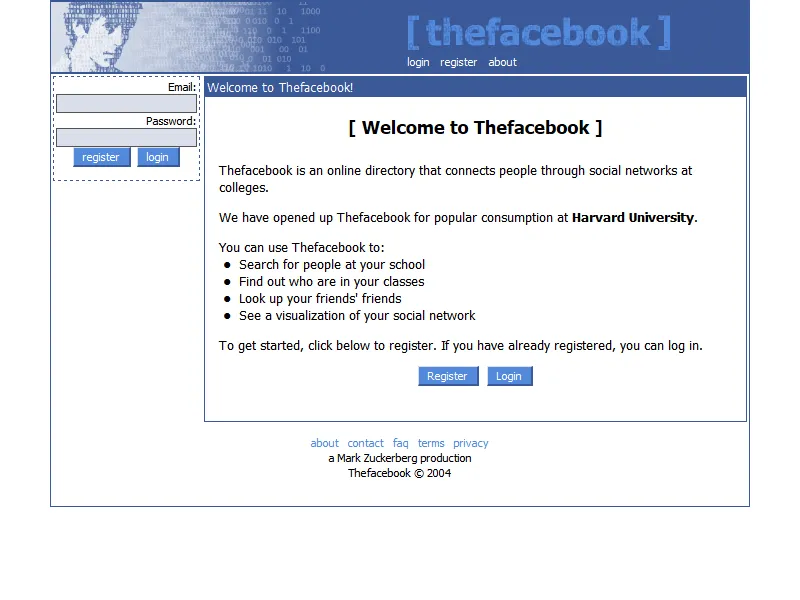
Kindly note: As a high-performance software engineer, there is no way you will ever work on a project or start your own project without encountering different versions. They come with major or minor upgrades, features, or bug fixes. For example, the first version of Facebook (https://www.firstversions.com/2015/04/facebook.html) was very basic compared to the latest version of Facebook (https://facebook.com/) you will find online. To understand HTML5 nuances properly, you need to understand the root. That’s just the way life is; you can never be a master and high-performance software engineer without understanding the basics.
Below is the screenshot of Facebook in 2004 and below that is Facebook in 2024:

HTML Versions Overview
HTML 1.0
The first version of HTML was 1.0, which was the barebones version of the HTML language. It was released in 1991.
HTML 2.0
This was the next version, released in 1995. It was the standard language version for website design. HTML 2.0 was able to support extra features such as form-based file upload and form elements such as text boxes and option buttons.
HTML 3.2
HTML 3.2 was published by W3C in early 1997. This version was capable of creating tables and providing support for extra options for form elements. It could also support web pages with complex mathematical equations. It became an official standard for any browser until January 1997. Today, it is practically supported by most browsers.
HTML 4.01
HTML 4.01 was released in December 1999 and is a very stable version of the HTML language. This version is the current official standard and provides added support for stylesheets (CSS) and scripting ability for various multimedia elements.
HTML5
HTML5 is the newest version of HyperText Markup Language. The first draft of this version was announced in January 2008, but the major release was in 2014. There are two major organizations involved in the development of the HTML5 version: W3C (World Wide Web Consortium) and WHATWG (Web Hypertext Application Technology Working Group).